
Is Full Grain Leather Worth It? An Honest Buyer's Verdict
Last Updated: November 1, 2026
Quick Summary
Full grain leather is worth it when the hide is well tanned and the construction supports it, because the intact grain layer resists abrasion and can be repaired rather than replaced. Run the cost-per-year math: a $75.00 full-grain belt worn daily for ten years costs about $7.50 per year.
- Top-grain leather has its surface sanded down, which thins the strongest part of the hide.
- Genuine leather is the lowest grade that can legally carry the word leather.
- Full grain absorbs liquids more readily than coated top-grain, so spills can leave marks.
- Condition full grain a few times a year and never use harsh soaps, alcohol, or household cleaners.
- Skip the premium if you replace accessories yearly or need a spotless, uniform surface.
Table of Contents
- What Full Grain Leather Actually Is and Why It Costs More
- Full-Grain Leather vs. Top-Grain Leather: The Grain Layer Test
- Full-Grain Leather vs. Genuine Leather: Why the Label Misleads
- How to Identify Full-Grain Leather Before You Buy
- Durability, Patina, and the Long-Term Cost Per Year
- Full-Grain Leather Care: What It Demands and What It Tolerates
- Where Full-Grain Leather Makes Sense and Where It Doesn't
- Choosing a Full-Grain Belt or Wallet That Earns Its Price
- Frequently Asked Questions
What Full Grain Leather Actually Is and Why It Costs More
Full grain leather is the top layer of a hide with its natural grain left completely intact, and it costs more because tanneries can only produce it from the best sections of the best hides.
That intact grain layer is where the fiber structure is densest, holding the leather together, resisting wear, and taking on a patina as oils work into the surface.
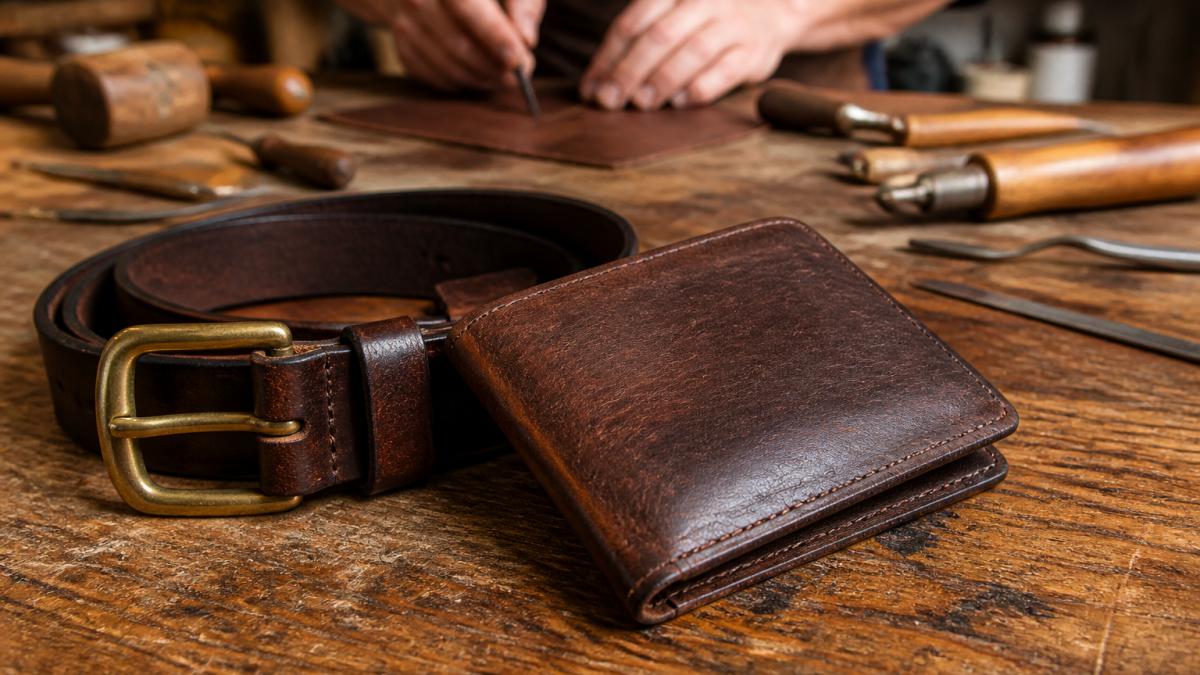
Full-grain hides are the material behind the belts and wallets we make, because the grain layer is what gives leather its strength. You can read a fuller hands-on guide to telling full grain leather if you want to check a hide yourself before spending money.
Full grain is not automatically good leather. A poorly tanned full-grain hide can crack and dry out. Grade describes what was left on the hide, not how well it was treated.
Full-Grain Leather vs. Top-Grain Leather: The Grain Layer Test
The difference between full-grain leather and top-grain leather comes down to one step: top-grain has its surface sanded down.
That sanding makes the leather look more consistent across a production run, which is why so much mass-market furniture uses it, but it also thins the strongest part of the hide.
The test is simple. Look closely at the surface at an angle. Full grain shows irregular pore patterns, tiny natural markings, and variation from one square inch to the next. Top-grain looks suspiciously even.
One more thing: top-grain is not a scam. It is reasonable for a bag that needs to look uniform, or a piece where stain resistance beats patina. It just should not cost full-grain money.
Full-Grain Leather vs. Genuine Leather: Why the Label Misleads
"Genuine leather" is the most misleading term in the industry. It sounds like a mark of quality.
Those split layers get coated with a polyurethane or vinyl finish to look like leather, over a loose, weak fiber structure. This is the material that peels, cracks, and fades on cheap belts and wallets within a year or two, the finish fails before the leather does.
A product can be labeled genuine leather and still be a coated split. The word tells you almost nothing.
So when you compare full-grain leather vs. genuine leather, you are not comparing two quality tiers of the same thing, but an intact hide against a reconstructed surface.
How to Identify Full-Grain Leather Before You Buy
You can verify most full-grain claims in under a minute with your hands and eyes. Start with these checks:
- Look for irregularity. Natural grain varies in pore size and pattern across the surface. Uniformity is a warning sign.
- Press the surface. Full grain wrinkles into fine, irregular creases. Coated leather tends to feel plasticky and springs back flat.
- Check the edges. A cut edge on full grain shows tight, dense fibers. Coated split leather shows a fuzzy core under a thin skin.
- Smell it. Real leather smells like leather. Heavy chemical or plastic smells usually mean a synthetic finish.
- Ask what tannery made the hide. A maker who knows their material can name it. Vague answers about "premium leather" are not answers.
If you are buying online, watch for "full-grain" used with no tannery, no thickness, and no origin. If a seller cannot state the leather's weight in ounces or millimeters, treat the claim as unproven.
For a second layer of confidence, these at-home authenticity tests catch the coated and bonded stuff that photographs well but feels wrong in person.
Durability, Patina, and the Long-Term Cost Per Year
A full-grain belt or wallet is not cheap up front, and it is not supposed to be. The question is what it costs you per year of use.
Across daily-wear accessories in general, the pattern tends to look like this:
- Coated or bonded leather belt: lower up-front price, but the surface finish is the failure point. Coatings on this type of belt can crack, peel, or separate at the buckle and holes with daily use. Cost per year is the price divided by that short life, and the item usually cannot be repaired.
- Top-grain belt: mid-range price, better fiber structure than a coated split, but the sanded surface tends to show scuffs and edge wear sooner than full grain. Expect several years of daily wear before replacement, depending on construction.
- Full-grain belt: highest up-front price, but the intact grain layer resists abrasion at the holes and buckle fold, and a stitched, screw-constructed belt can be re-edged, re-conditioned, and have its buckle swapped. A well-made full-grain belt can last a long time with basic care.
The math can favor the better material even at a higher sticker price, but only if the full-grain piece is well made.
What drives the lifespan. Durability comes from that dense grain layer: it resists abrasion, holds stitching better, and does not delaminate, because there is no coating to peel.
Handmade Wickett & Craig Harness Leather Belt — Dark Brown, Full-Grain →
Repair and replacement frequency. Full-grain leather is often easier to repair than coated leather.
Patina is part of the value equation. Full grain darkens, softens, and takes on the marks of your actual life.
When the premium does not pay off. If you replace accessories yearly for fashion, the durability premium is wasted. If the item is a matched set that needs uniform appearance, natural variation works against you. And if stain resistance is your top priority, a coated surface may serve you better despite the shorter life. The cost-per-year framework answers the money question, not the preference question.
Full-Grain Leather Care: What It Demands and What It Tolerates
Care is where full grain asks for a little more and gives back a lot. For the full set of practical maintenance steps for leather belts, follow a simple routine.
What it tolerates. Daily wear, rain that gets wiped off promptly, sunlight in normal doses, and handling. Full grain is forgiving because the grain layer is intact and the fibers are dense.
What it does not tolerate. Soaking wet storage, prolonged heat, and neglect.
The stain trade-off, explained. This is the honest weak spot. Full grain absorbs liquids more readily than a coated top-grain surface because the grain layer is open and unfinished. A splash of oil, coffee, or dark liquid can leave a mark. How that mark behaves depends on the finish:
- Vegetable-tanned full grain (common in belts and straps) is the most absorbent. It takes on water spots and oil marks readily, but those marks often blend into the patina over months of handling. It is the most rewarding to age and the least forgiving on day one.
- Chrome-tanned or hot-stuffed full grain (such as Chromexcel-style leathers) carries waxes and oils that give it more water resistance out of the box. It still absorbs, but more slowly, and tends to darken rather than spot.
- Coated top-grain wins on wipe-clean stain resistance because the surface is sealed, the one metric where coated leather clearly beats full grain.
How conditioning changes the picture. Routine conditioning can help replenish oils and improve water resistance, but full grain is not stain-proof.
Spill response. Blot, do not rub. Rubbing drives a spill into the grain.
Where Full-Grain Leather Makes Sense and Where It Doesn't
Full grain earns its price in products that take daily abuse and are meant to be kept: belts, wallets, work bags, boots, watch straps, and anything you carry every day for years. It also suits furniture and upholstery where the buyer wants a piece that ages rather than wears out.
It makes less sense for fashion items you plan to replace in a season, products that need a uniform look across a large matched set, and situations where stain resistance is the top priority.
Quality varies within full grain too. A thick, well-tanned hide from a respected tannery behaves nothing like a thin, hastily finished one. Thickness, tannage, and finishing decide how a piece actually performs. Ask about all three.
Choosing a Full-Grain Belt or Wallet That Earns Its Price
A full-grain piece earns its price when four things line up: a named tannery, honest thickness, construction that matches the material, and a maker who stands behind it. Miss any one and you are paying a premium for a label.
Here is how our own line stacks up against those criteria:
| Product | Leather | Price | Best For |
|---|---|---|---|
| Wickett & Craig Harness Belt | Full-grain veg-tan, 12 oz | $75.00 | Daily wear, ages into deep patina |
| Horween Chromexcel Belt | Full-grain Chromexcel, 9/10 oz | $75.00 | Supple from day one, dressier look |
| Water Buffalo Belt | Full-grain Water Buffalo, 8/9 oz | $60.00 | Rugged casual wear, workwear |
| The Kevin, Horween Bifold | Full-grain veg-tan Horween | $85.00 | Slim carry, classic patina |
| The Kevin, American Bison | Full-grain American Bison | $85.00 | Bold grain, soft hand |
Each belt is hand-cut and finished to your measurement, with Chicago screws so you can swap the buckle. You can browse the handmade full-grain belt or see the Horween bifold wallet to compare specs directly.


Best for: buyers who want one piece to last a decade or more and don't mind a little patina. Skip if: you want a spotless, uniform surface or you replace accessories yearly.
Frequently Asked Questions
Is full grain leather worth the extra cost?
For items you use daily, usually yes. A full grain leather belt or wallet carries the intact grain layer, so it resists cracking and peeling far longer than corrected or bonded leather. Spread over five to ten years of use, a $75 belt costs a few dollars a year, which often beats replacing a cheap belt every twelve months. The math changes for items you wear rarely or want in a trend color.
How long does full grain leather last?
With basic care, full grain leather goods can last many years, and belts and wallets are often among the longest-lived items in a wardrobe. The intact grain layer is the strongest part of the hide, so it takes scuffs and flexing without splitting. Longevity still depends on thickness, stitching, and how often the piece dries out completely.
Does full grain leather scratch or stain easily?
It scratches more visibly than corrected grain because the natural surface is left intact, but most light scratches buff out with a fingertip or a little conditioner. Water spotting and oil stains are the bigger risk. A wax-based conditioner before first use adds some water resistance, and you should blot spills rather than rub them.
How can you tell if leather is genuinely full grain?
Look at the surface under good light. Full grain shows irregular pores, subtle color variation, and natural markings rather than a uniform, plastic-smooth finish. Check the cut edge on a belt: full grain is solid fiber all the way through, not a thin top layer over a spongy core. Ask which tannery supplied the hide, since named tanneries are traceable.
The real test of full-grain leather is time, and most buyers never get to see it because they quit at the price tag. If you want a belt or wallet built to be the last one you buy, Benson Leather Goods hand-cuts and hand-stitches every piece in our Michigan workshop from full-grain Wickett & Craig, Horween, and American Bison leather. Order from our catalog and get a piece that earns its price over years, not months.
